Education
Permaculture education is about learning how to design human environments—gardens, farms, homes, communities, and organisations—so they work with natural systems rather than against them.
It goes beyond gardening and food production. Permaculture education develops an understanding of ecological systems, practical skills, social relationships, and the invisible structures that shape how society functions.
What does permaculture education include?
Permaculture education combines practical, ecological, and social learning. It can include:
Growing food and caring for soil — organic growing, composting, seed saving, biodiversity and regenerative land practices.
Working with natural resources — water conservation, energy, waste reduction and appropriate technologies.
Ecological design — designing homes, gardens, farms and settlements to be productive, resilient and resource-efficient.
Systems thinking — understanding relationships, patterns and how changes in one part of a system affect another.
Social Permaculture — exploring how people can cooperate, communicate, make decisions and create healthy, resilient communities.
Ethical decision-making — considering the social and environmental consequences of our choices and using ethics as a foundation for action.
Fair and regenerative economics — examining how money, resources, work and value are distributed, and exploring economic systems that support people and ecosystems rather than exploiting them.
Business and organisational structures — learning how enterprises and organisations can be designed around ecological responsibility, fairness, cooperation and long-term resilience.
Invisible structures — exploring the intangible systems that influence society, including culture, values, power, governance, relationships, economics, beliefs and patterns of decision-making.
Who is permaculture education for?
Permaculture education can benefit anyone interested in creating more sustainable and resilient ways of living. This includes home gardeners, farmers, educators, students, families, community groups, designers, planners, businesses and organisations.
It can be particularly valuable for people who want to move beyond individual sustainability practices and understand how the wider systems around us influence our lives and our environment.
What are the benefits?
Practical capability
Learners gain practical skills for growing food, improving soil, managing water, reducing waste and designing productive spaces.
Ecological understanding
Permaculture helps people understand natural patterns and relationships, encouraging designs that support biodiversity, regeneration and resource efficiency.
Systems thinking
Rather than seeing problems in isolation, learners develop the ability to recognise connections between ecological, social and economic systems.
Social resilience
Social Permaculture encourages cooperation, communication, shared responsibility and healthy relationships, helping communities become more connected and resilient.
Ethical awareness
Learners are encouraged to consider not only “Does this work?” but also “Is this fair, responsible and beneficial to people and the living world?”
Economic resilience and fairness
Exploring invisible economic structures can help people question how value is created and distributed, and consider business and economic models that are more equitable, regenerative and locally resilient.
Empowerment and agency
Perhaps most importantly, permaculture education helps people recognise that they can participate in designing systems, rather than simply adapting to systems that already exist.
In essence
Permaculture education is about learning to see the whole system—both what is visible and what is invisible.
The visible might be a garden, farm, building or community space. Beneath it are the invisible structures: relationships, values, ethics, culture, economics, governance, power, cooperation and decision-making.
By learning to understand and redesign both, permaculture education aims to help people create systems that are ecologically regenerative, socially just, economically fair and resilient over the long term.
There are a range of ways to learn about Permaculture including self-directed learning from books, the internet and other people, and then more formal education including a Permaculture Design Certificate (PDC) and a Diploma.
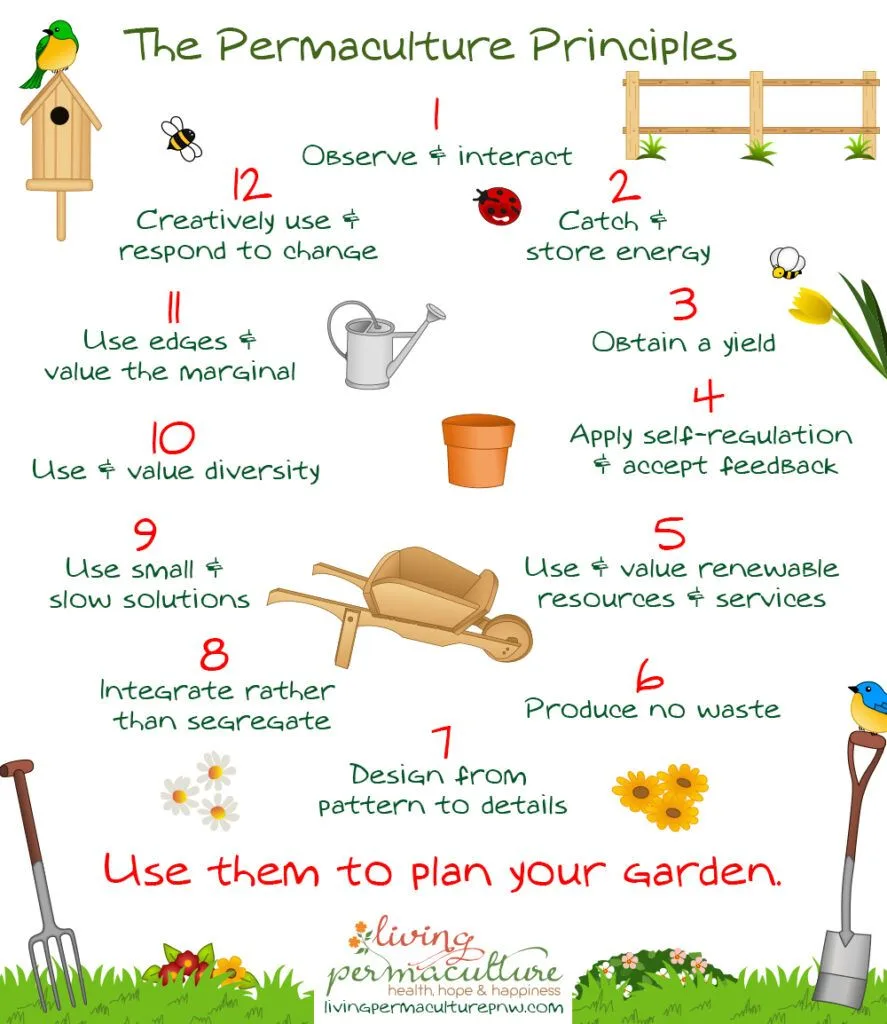
Permaculture principles